
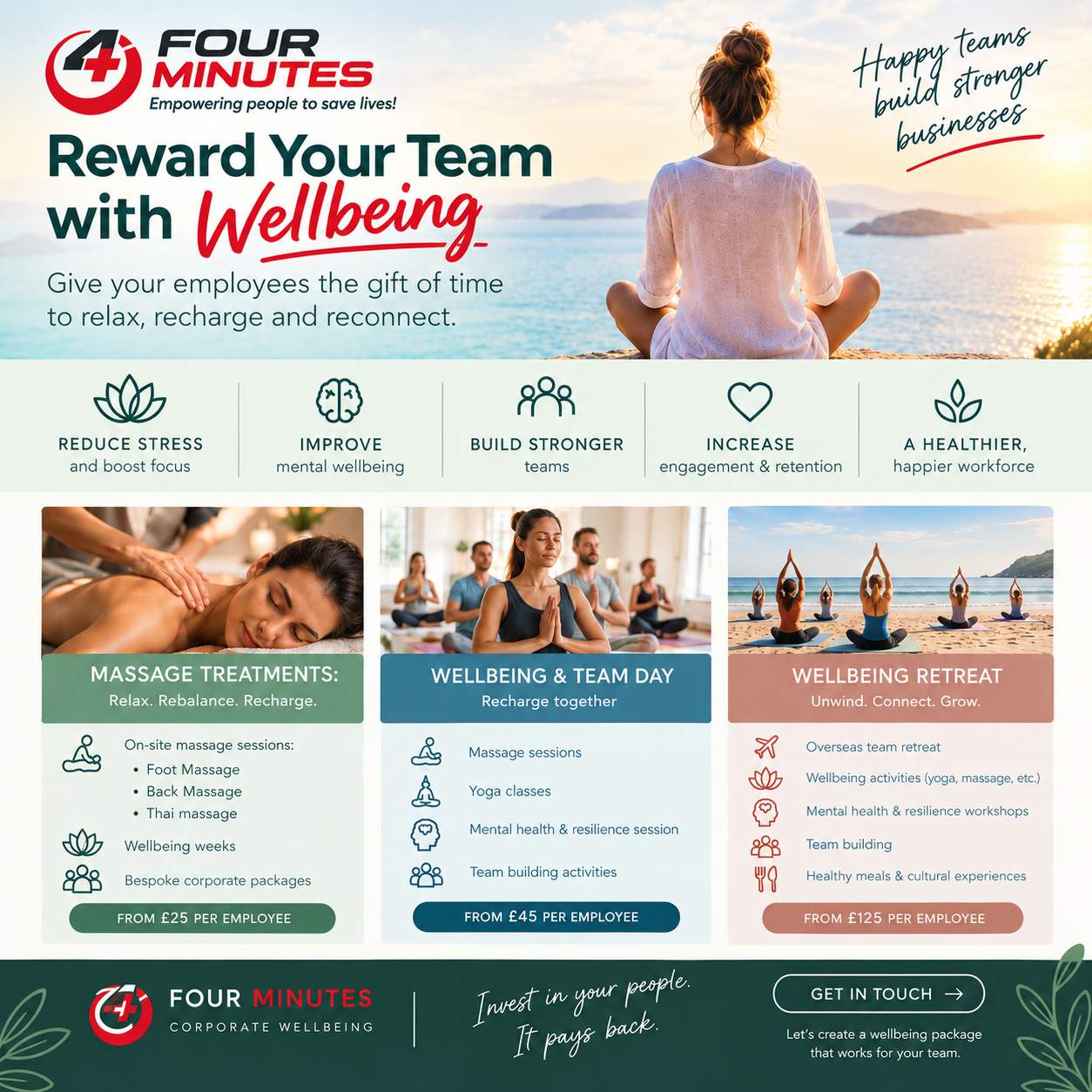
Reward Your Team with Wellbeing: Why Investing in Your People Matters
What makes a good employee reward?
For some people, it might be a gift voucher or a nice lunch. For others, it could simply be having a bit of time to step away from work, switch off and do something that makes them feel good.
That’s why wellbeing experiences are becoming an increasingly popular way for businesses to thank their teams.
At Four Minutes, we already work with organisations on mental health, resilience and workplace wellbeing. Our corporate wellbeing packages build on that work, giving companies the option to offer their teams something practical and enjoyable — from massage and yoga sessions to wellbeing days and team retreats.
It’s a simple idea: give people an experience they can actually enjoy, rather than another item to take home.
Wellbeing is more than just another workplace perk
It’s easy to think of employee wellbeing as something that sits alongside the “real” business priorities.
But how people feel at work can have a big impact on how they work, how they interact with colleagues and whether they want to stay with an organisation.
The Chartered Institute of Personnel and Development (CIPD) recognises the role that health and wellbeing can play in employee engagement and organisational performance. Its guidance also highlights the importance of supporting good mental health through prevention, early intervention and practical support.
That doesn’t mean a yoga class or massage can solve every workplace problem. It can’t.
What these activities can do is give people a chance to stop for a moment, take a breath and feel that their employer is making an effort to look after them.
And sometimes, that matters.
Give your team permission to switch off
Work can be relentless.
There are emails to answer, meetings to attend, deadlines to meet and phones that rarely seem to stop.
Even when someone has finished their working day, it can be difficult to properly switch off.
Offering employees some dedicated time during the working day to step away from their usual routine can be a welcome change.
A short massage. A lunchtime yoga session. A guided breathing exercise.
None of these needs to take up an entire day. In fact, sometimes 20 or 30 minutes is enough to give someone a proper break from their desk and allow them to reset.
Research into approaches such as yoga and massage has also found potential benefits in helping to reduce measures of occupational stress.
Massage: a simple way to say thank you
Imagine being able to book a short massage at work instead of having to arrange an evening out after a busy day.
For employees, it’s a chance to step away from their workload and focus on themselves for a little while.
For employers, it’s a straightforward way to show appreciation.
Corporate massage can work well as part of:
- Individual employee massage sessions
- On-site workplace massage days
- Staff appreciation events
- Wellbeing weeks
- Team reward days
- Bespoke corporate wellbeing programmes
It’s personal, practical and, most importantly, something people can enjoy.
Yoga: a chance to slow down
Corporate yoga offers something a little different.
A workplace session can give employees the chance to stretch, move, breathe and take a proper break from sitting at a desk or rushing from one meeting to another.
It can also be a nice activity for teams to do together.
You don’t need to be particularly flexible or experienced. A good workplace yoga session can be adapted to suit different abilities and can focus on simple movement, breathing and relaxation.
For businesses looking at ways to support stress management and encourage healthier working habits, yoga and mindfulness can be useful additions to a wider wellbeing programme.
Why give another gift when you can give an experience?
We all receive things that we don’t really need.
Another mug. Another box of chocolates. Another gift voucher that gets put in a drawer and forgotten about.
Experiences tend to be different.
A team wellbeing day or retreat gives people something to look forward to and, in many cases, something they’ll remember afterwards.
For companies wanting to take things further, a retreat abroad can combine several elements of wellbeing and team development in one experience.
For example:
- Yoga and movement sessions
- Guided breathing and relaxation
- Massage and wellbeing treatments
- Mental health awareness sessions
- Resilience workshops
- Team-building activities
- Shared meals
- Free time to relax
- Cultural and destination experiences
Getting people out of the usual work environment can also change the dynamic within a team.
People have the opportunity to talk to colleagues they might not normally work closely with, experience something new together and simply enjoy some time away from their everyday routine.
The idea isn’t to turn a work trip into a holiday.
It’s about creating an experience that combines reward, connection and wellbeing.
What does a wellbeing reward say about your company?
The way a business rewards its people says something about its culture.
If recognition is always tied to targets, sales figures or performance, employees may understandably feel that what matters most is what they produce.
Wellbeing rewards send a slightly different message.
We appreciate what you do.
We want you to look after yourself.
We care about the people behind the job title.
That doesn’t replace fair pay, good management or a healthy working environment. But it can form part of a wider approach to employee experience.
The CIPD also recommends having clear objectives when designing employee benefits, rather than simply adding benefits because they sound appealing.
That’s something worth considering when planning a corporate wellbeing programme. What are you hoping to achieve? Are you looking to thank your staff, bring a team together, support a wellbeing initiative or simply give people a chance to take a break?
Once you know that, it becomes much easier to choose the right experience.
Corporate wellbeing experiences from Four Minutes
At Four Minutes, our approach to wellbeing is practical and people-focused.
Our corporate sessions can be booked individually or combined to create a programme around your organisation.
Massage
Give your team the chance to step away from work and enjoy a relaxing massage during the working day.
Yoga
Accessible, guided yoga sessions incorporating movement, breathing and relaxation.
Wellbeing & Breathing Sessions
Simple techniques that employees can use during busy working days to pause, breathe and manage everyday pressure.
Mental Health & Resilience Sessions
Interactive sessions designed to increase awareness of mental health, help people recognise when something may not be right and understand where they can find further support.
Team Building
Activities that give colleagues the opportunity to connect outside their normal working environment and build stronger relationships.
Wellbeing Retreats Abroad
Take your team somewhere completely different and combine wellbeing, relaxation, travel and team development into one memorable experience.
Make your next employee reward a little different
Your employees give your organisation their time, skills and energy every day.
So perhaps the next reward doesn’t need to be something that sits on a desk or gets put in a cupboard.
It could be an hour to relax.
A yoga session with colleagues.
A wellbeing day.
A chance to get away together.
Or even a retreat somewhere completely new.
Whatever you choose, the message is the same: we appreciate you, and we want you to have time to look after yourself too.
At Four Minutes, we can help you create a corporate wellbeing package around your organisation, whether you’re planning a staff appreciation day, a workplace wellbeing event or a team retreat abroad.
Give your team the gift of wellbeing.
Get in touch with Four Minutes to discuss your requirements and create a wellbeing experience that’s right for your people.